
Wedding Guest List Calculator
To find how many invitations your wedding guest list needs, divide the guests you want by the share who will say yes, rounded up. The calculator takes your A, B and C lists and returns the invitations to send, the expected headcount, a worst case where everyone says yes, a venue capacity check and the all-in cost per guest. The yes percentages are a rule of thumb, so replace them with your own RSVP data.
Free · runs in your browser · nothing is uploaded
Recent
Your last 10 settings, saved only in this browser. Nothing is uploaded.
At a glance
The wedding guest list calculator works out how many invitations to send to reach a target headcount, based on the share of each list you expect to say yes. Its default percentages are a rule of thumb that you replace with your own RSVP data.
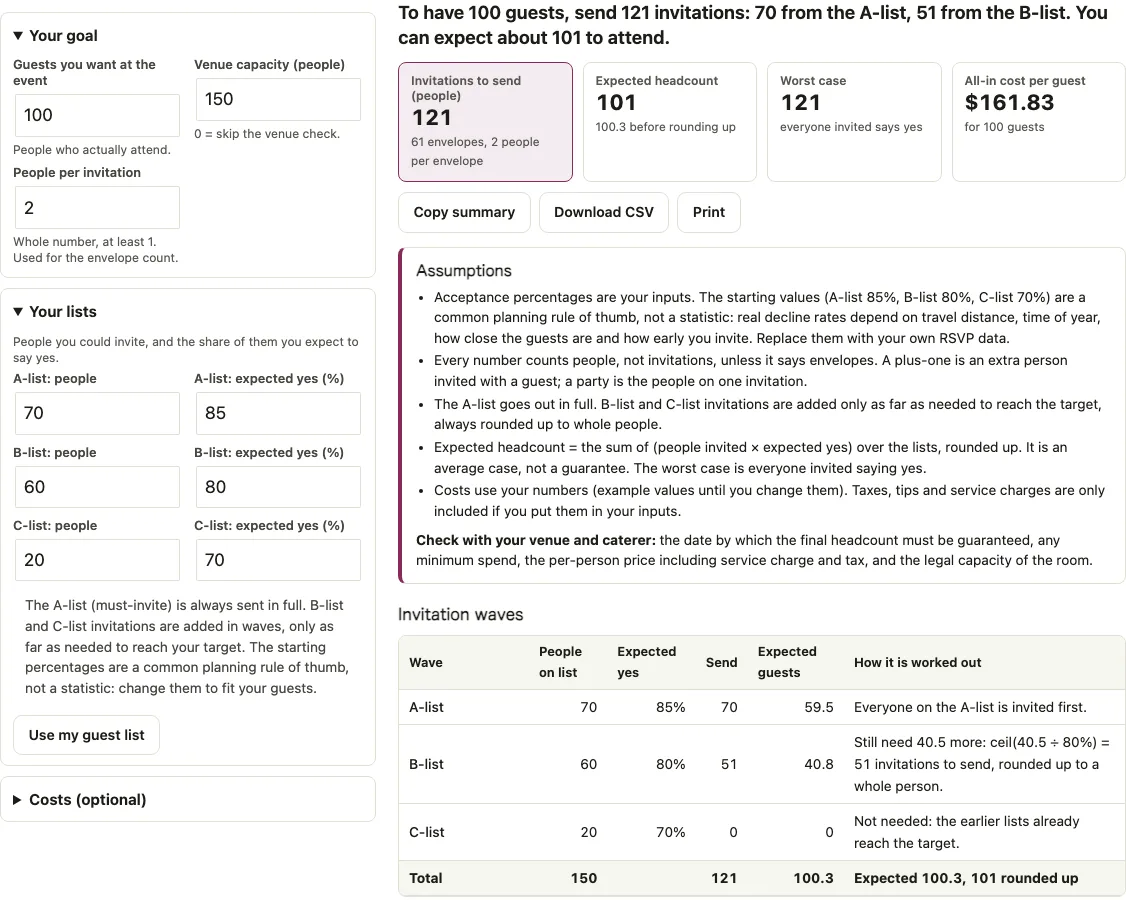
- With the starting numbers, a target of 100 means sending 121 invitations.
- For one list, 100 guests at 85% need 100 / 0.85 = 117.6, so 118 invitations.
- People per invitation is a whole number of at least 1, and it gives the envelope count.
- Leave Venue capacity at 0 to skip the venue check.
- With venue capacity 150, the worst case of 121 fits with 29 to spare.
Last checked:
How to use the wedding guest list calculator
- Enter Guests you want at the event. This is the number of people who actually attend.
- Enter Venue capacity. Leave it at 0 to skip the venue check.
- Set People per invitation, a whole number of at least 1, which gives the envelope count.
- Under “Your lists”, enter the people on the A-list, B-list and C-list and the expected yes (%) for each.
- Optional: open “Costs”, pick a currency and enter food and drink per guest, other cost per guest, cost per invitation and fixed costs.
- Read the headline and the four figures: Invitations to send (people), Expected headcount, Worst case and All-in cost per guest.
- Check the Invitation waves table, the Venue capacity check and the table What if fewer people accept?
- If you already track guests, click Use my guest list to load the A, B and C counts from the wedding guest list template. Use X% as acceptance then sets all three lists to the yes rate of the replies so far.
Copy summary, Download CSV and Print sit above the results. Your inputs are written into the page address, so a saved link reopens the same scenario. The starting values, including every cost, are examples to replace with your own quotes.
How many invitations do I need to send?
Divide the guests you want by the share who will say yes, and round up to a whole person. For one list, 100 guests at 85% need 100 / 0.85 = 117.6, so 118 invitations. With several lists the calculator works in waves: the A-list always goes out in full, then B and C invitations are added only as far as needed.
Worked example with the starting values (target 100, A-list 70 people at 85%, B-list 60 at 80%, C-list 20 at 70%):
- The A-list of 70 at 85% gives 59.5 expected guests.
- That leaves 100 - 59.5 = 40.5 still needed.
- The B-list needs 40.5 ÷ 80% = 50.6, rounded up to 51 invitations (the tool prints ceil(40.5 ÷ 80%) = 51), which gives 40.8 expected. Nine B-list people are held back.
- The C-list is not needed, so its 20 people are held back.
That is 121 invitations (70 + 51), or 61 envelopes at 2 people each. The expected headcount is 59.5 + 40.8 = 100.3, shown as 101. If you used one list only, the invitations needed for a target of 100 would be:
| Expected yes | Invitations needed |
|---|---|
| 90% | 112 |
| 85% | 118 |
| 80% | 125 |
| 75% | 134 |
| 70% | 143 |
| 60% | 167 |
Where do the 85%, 80% and 70% come from?
They are a common planning rule of thumb, not a statistic, and the calculator labels them that way. Real decline rates depend on travel distance, time of year, how close the guests are and how early you invite. No percentage here is attributed to a survey or a publication, so replace all three with what your own RSVPs show.
When replies start to arrive, Use my guest list reads them. With 40 yes, 8 no and 22 not yet answered, the yes rate is 40 / 48 = 83%, and if the 22 answer the same way about 59 people would come (maybes are not counted).
What if fewer people accept?
The sensitivity table assumes all 150 people on the three lists are invited with the same yes rate on each list. The cost column uses your cost inputs.
| Expected yes | Expected guests | Invitations to reach 100 |
|---|---|---|
| 60% | 90 | 167 |
| 70% | 105 | 143 |
| 80% | 120 | 125 |
| 90% | 135 | 112 |
| 95% | 143 | 106 |
Lower acceptance can leave you short even when everyone is invited. With A at 70% yes, B at 65% and C at 55% (the same 150 people), the expected headcount is 49 + 39 + 11 = 99, one short of 100. The calculator then says how many guests you are short and suggests adding people to a list or raising a yes percentage if that is realistic.
How do I check the venue and the cost per guest?
The venue check compares the worst case, where everyone invited says yes, with the capacity you entered. With capacity 150, the worst case of 121 fits with 29 to spare. At capacity 110 the worst case is 11 too many, although the expected 101 still fits, so confirm the room’s limit with the venue before the invitations go out.
Cost per guest at the target of 100 is (100 x (65 + 15) + 61 envelopes x 3 + 8,000) / 100 = 16,183 / 100 = 161.83. At 101 expected guests it is 161.02, and at the worst case of 121 it is 147.63. Taxes, tips and service charges count only if you put them in your inputs.
Short answers to common questions
How many people should I invite to a wedding?
That depends on the guests you want and your yes rates, which is what the calculator works out. With the starting numbers, 121 invitations bring about 101 guests for a target of 100. The page does not suggest a typical guest count.
What is a B-list for wedding guests?
The B-list is the second wave: people invited later, only as far as needed to reach your target. Here, B-list invitations are added after the A-list, and anyone not needed stays on hold.
Does a wedding guest list include the bride and groom?
The calculator counts the people you enter. If you want your own seats counted, include yourselves in the target and in the A-list.
How early should I finalise my guest list?
Ask your venue and caterer for the date by which the final headcount must be guaranteed, and work back from it. The calculator lists that date, any minimum spend, the per-person price and the legal capacity as things to check.
Is the expected headcount a guarantee?
No. It is an average case based on your percentages, rounded up to a whole person. The worst case, everyone invited saying yes, is the highest number you could see.
What if my lists fall short of the target?
The calculator tells you by how much. With 40 people on the A-list, 30 on the B-list and nobody on the C-list, everyone is invited (70 invitations), about 58 are expected (40 x 85% + 30 x 80%) and you are 42 guests short.
Where do the 85%, 80% and 70% yes rates in the wedding guest list calculator come from?
They are a common planning rule of thumb, not a statistic, and the calculator labels them that way. Real decline rates depend on travel distance, time of year, how close the guests are and how early you invite. Replace all three percentages with what your own RSVPs show.
How many invitations do I need to send for 100 wedding guests?
With the starting values, a target of 100 means sending 121 invitations: 70 to the A-list and 51 to the B-list. For a single list at 85% yes, 100 guests need 118 invitations. The calculator sends the A-list in full, then adds B and C invitations only as far as needed.
Related tools
Use the calculator once you know your lists, then move to the next planning step.
- Wedding guest list template: when you want to keep the names, RSVPs and meals behind the A, B and C counts.
- Guest list template: when you want a printable sheet to tick off replies.
- Wedding alcohol calculator: when the expected headcount is set and you need drinks.
- Room capacity calculator: when you need to check how many people a room can hold.
- Wedding reception layout: when you want to plan the room for that headcount.
- Wedding seating chart: when guests have confirmed and need tables.
- Wedding table numbers: when the tables need numbers.